Passive Components are devices that do not require electrical power to operate on the optical signal.
How Do They Work?
Passive components function by manipulating light using four fundamental physical principles:
Reflection: Bouncing light off surfaces to change its direction.
Refraction: Bending light as it passes through different materials.
Interference: Combining or splitting light waves based on their phase and wavelength.
Absorption: Purposefully soaking up light energy to reduce signal strength.
They Important?
Energy Efficient: Since they don’t need electricity, they save power costs and don’t generate heat.
Durability: Without complex electronic circuits, these parts are highly reliable and have a long lifespan.
Reliability: They continue to function even during a power outage, ensuring the physical path for light remains open.
Key Examples
Mux/Demux (Multiplexer): Merges several light signals into one fiber or separates them back out.
Couplers/Splitters: A fiber coupler is a passive component used to either split an optical signal into multiple paths (Split) or combine multiple signals into a single fiber (Combine). .like a Y-junction.
Isolators: Acts as a “one-way street,” allowing light to travel forward but blocking harmful reflections from coming back.
Circulators: A multi-port device that routes light in a specific sequence (Port 1 to 2, Port 2 to 3).
Attenuators: Reduces the power of a signal if it is too bright for the receiver.
Filters: Allows only specific “colors” (wavelengths) to pass through while blocking others.
An Optical Switch
is a device that routes an incoming optical signal from one input fiber to one of several output fiber
Direct Optical Conversion (All-Optical):
Its greatest advantage is that it performs the entire task completely in the optical domain. This means it does not convert light into electricity to redirect the signal. This maintains high speed and reduces latency.
Wavelength Converter
Explanation: This device changes the wavelength (color) of an incoming signal to a different wavelength for the outgoing signal.
The Problem (Wavelength Contention): In fiber networks, “contention” happens when two different signals try to use the exact same wavelength on the same fiber at the same time. It’s like two cars trying to occupy the same spot in a single lane.
The Solution: The converter changes the wavelength of one signal so they can travel together without interfering with each other.
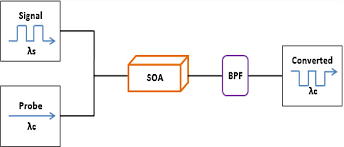
This diagram shows how a wavelength converter works using an SOA:
Input Signals: Two signals enter the system:
Signal ($\lambda_s$): The original data signal at a specific wavelength.
Probe ($\lambda_c$): A continuous wave at the new target wavelength.
SOA (Semiconductor Optical Amplifier): This is where the conversion happens. Inside the SOA, the data from the original signal ($\lambda_s$) is transferred onto the probe signal ($\lambda_c$) through a process called Cross-Gain Modulation (XGM).
BPF (Band Pass Filter): This filter blocks the old wavelength ($\lambda_s$) and only allows the new, converted wavelength ($\lambda_c$) to pass through.
Output: You get the same data, but now it is on a different “color” or wavelength.