WDM (Wavelength Division Multiplexing)
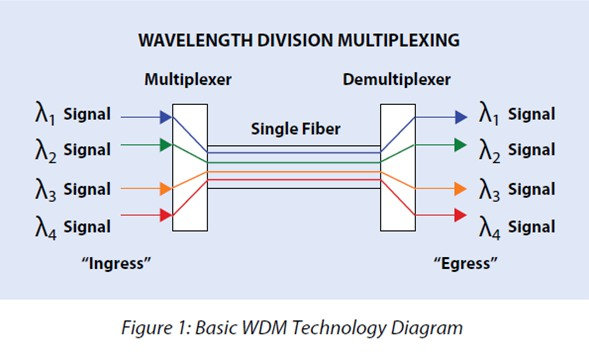
WDM is a technology that allows multiple data signals to be sent simultaneously through a single optical fiber. This is achieved by assigning a different “color” (wavelength) of laser light to each individual signal.
WDM is the "soulmate" of Single-mode fiber.
Requirements for the Transmitter (Laser Source)
For a WDM system to function correctly without data loss, the transmitter must meet three critical conditions:
A. Precision Wavelength
The laser must produce light at a very specific wavelength. If the wavelength shifts even slightly, it will interfere with the signal in the neighboring channel. This interference is called Crosstalk. It is similar to two radio stations overlapping; when signals mix, the data becomes corrupted.
B. Stability
Lasers are sensitive to temperature, which can cause their color or wavelength to drift. In WDM, the wavelength must remain perfectly constant. To ensure this, engineers use Wavelength Lockers—technology that keeps the laser “locked” to the correct wavelength regardless of heat or environmental changes.
C. Narrow Linewidth
The laser beam must be extremely “pure” or narrow. A narrow linewidth ensures that the light pulse spreads out less as it travels long distances. This significantly reduces the problems of Pulse Broadening and ISI (Intersymbol Interference) that we discussed previously.
A Wavelength Locker
is a feedback control system that keeps a laser’s wavelength (or “color”) fixed at a precise value. It is absolutely essential in WDM (Wavelength Division Multiplexing) systems.
Receiver Requirements
In a WDM (Wavelength Division Multiplexing) system, the receiver’s job is very challenging. It must find and process one specific signal from a group of many different “colors” (wavelengths) arriving at the same time. An ideal receiver must have three main qualities:
1. Selectivity
When multiple wavelengths reach the end of the fiber together, the receiver must be able to pick out the specific wavelength assigned to it while ignoring all others.
- Analogy: It is like a radio. Out of many available stations, you “tune” into one specific frequency to hear the music you want.
2. Sensitivity
As light signals travel hundreds of kilometers, they become very weak due to loss (Attenuation). The receiver must be sensitive enough to detect these extremely faint signals and accurately recover the original data.
3. Wide Bandwidth
Signals coming from the transmitter are extremely high-speed (e.g., 100 Gbps or 400 Gbps). The receiver’s electronic circuitry must be fast enough to handle this massive data rate.
- The Problem: If the receiver’s bandwidth is too low, it cannot process the bits fast enough, causing the data to become “blurred” or lost.
A Tunable Laser
While standard lasers emit a fixed “color” or wavelength, a Tunable Laser is special because its wavelength can be adjusted or “tuned” as needed.
Why is it Important for CSE?
In WDM (Wavelength Division Multiplexing) systems, dozens of different wavelengths are used simultaneously.
- The “Backup” Solution: If a specific laser fails, instead of keeping 80 different fixed lasers in stock, you can keep just one Tunable Laser. It can be programmed to mimic the wavelength of the failed laser and take over immediately.
Multiple Lasers = Multiple Channels
Each individual laser produces light at a specific, very precise wavelength (color).
- Flexibility: It allows network engineers to change the data path or channel remotely via software.
Types of Tunable Lasers
| Laser Type | How it Works | Key Feature |
|---|---|---|
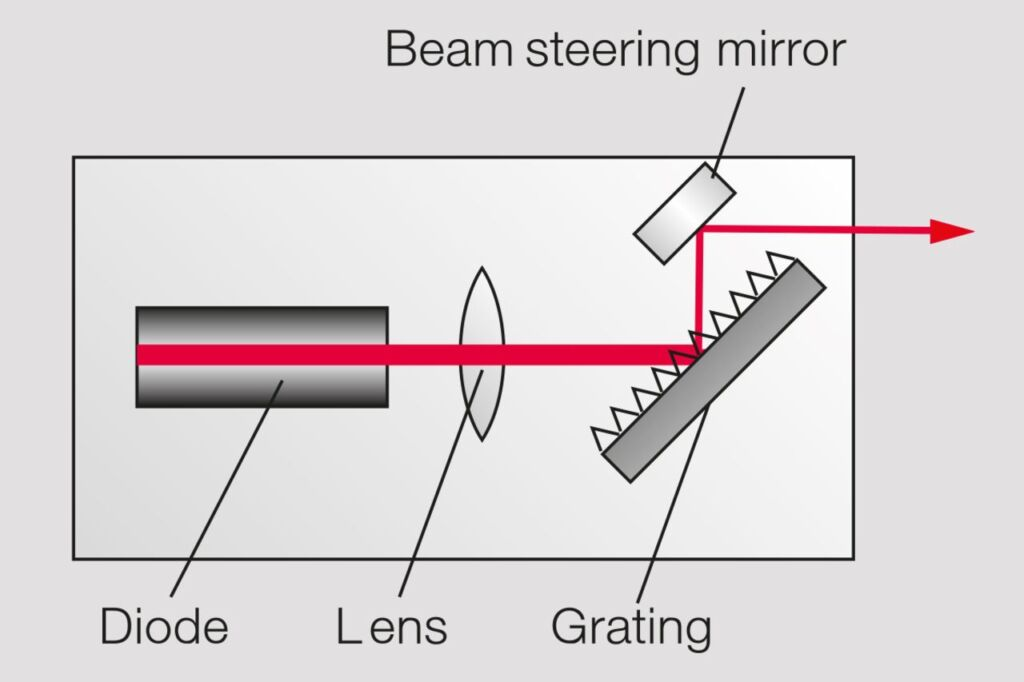
| External Cavity Lasers (ECL) | Uses a Physical Grating (a special mirror) that moves or rotates to change the color. | Extremely Precise and stable, but has a more complex mechanical design. |
| Distributed Bragg Reflector (DBR) | Uses electrical current to change the Refractive Index of an internal grating. | No moving parts. It is tuned electronically, making it very fast. |
| VCSEL (Vertical Cavity) | Uses MEMS technology to physically move a tiny mirror at the top. | Very Compact and Cheap; ideal for shorter distances. |
a "Cavity" (also known as an optical resonator) is a specific space or enclosure where light

is trapped between two reflective surfaces or mirrors and reflected back and forth repeatedly.
External Cavity Lasers (ECL) Distributed Bragg Reflector (DBR)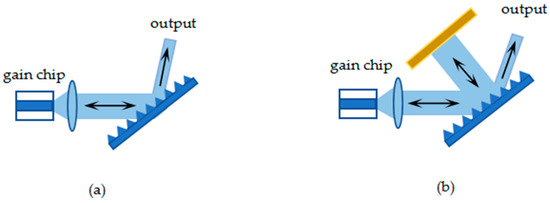
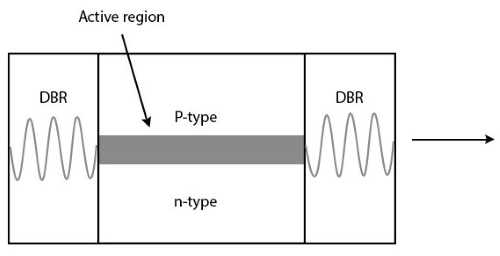
1. Light Generation
Light is generated within the central Active Region. This is where the electrical energy is converted into optical energy.

2. DBR Mirrors (Optical Feedback)
The DBR (Distributed Bragg Reflector) mirrors on both sides act as gratings. They trap the light inside the cavity, bouncing it back and forth to amplify it and make it stronger.

3. Light Emission
The arrow on the right side indicates that the laser emits a powerful, Single-frequency (single wavelength) light beam in one direction.

4. Key Advantages
Stability: It produces a very stable light signal that can travel long distances without losing its quality.

WDM Application: Because it can be tuned to a very specific wavelength, DBR Lasers are ideal for WDM (Wavelength Division Multiplexing) systems, where each channel requires its own unique wavelength.
MEMS Technology
Micro-Electro-Mechanical Systems (MEMS) are indeed tiny integrated devices or systems that combine electrical and mechanical components on a single silicon chip.
Real-Life Examples
The examples provided in your slides help make this concept clearer:
Mobile Phone Accelerometer: Have you noticed how your phone screen rotates automatically when you tilt it? A tiny MEMS sensor inside the phone detects the change in direction and tells the software to rotate the display.
Car Airbag Sensors: In the event of a collision, MEMS sensors detect the sudden impact instantly and trigger the airbags to deploy, saving lives in milliseconds.
Inkjet Printer Heads: The microscopic nozzles inside a printer are controlled by MEMS technology, which ensures that ink is sprayed onto the paper with extreme precision.
Optical Amplifiers
In long-distance fiber networks, signals lose strength as they travel (due to fiber loss or attenuation). In the past, engineers had to convert light into electricity, boost it, and convert it back to light, which was slow and expensive. Today, Optical Amplifiers allow us to boost the signal directly as light, without any conversion.
2. Key Requirements for an Amplifier
To maintain high-quality data transmission, an optical amplifier must meet three main criteria:
- Gain: This is the ratio of output power to input power. The amplifier must be strong enough to boost a very weak signal back to a usable level.
- Gain Flatness: In WDM systems, many colors (wavelengths) travel together. The amplifier must boost every color equally. If one color is boosted more than another, the data balance is ruined.
- Low Noise: Amplifiers naturally add some “hiss” or electrical noise. A good amplifier keeps this noise to a minimum so that the data remains clear.
Three types of amplifier for WDM
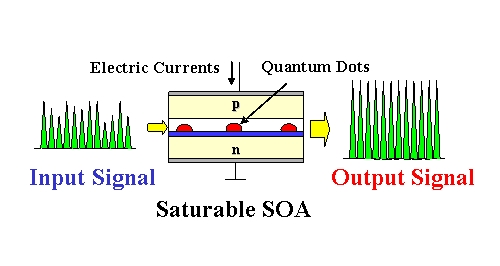
SOA (Semiconductor Optical Amplifier)
- How it Works: It uses a semiconductor chip similar to a laser, but without the internal mirrors.
Structure
- p and n layers:(is used because it acts as the “engine” that converts electricity into light energy.) This structure is similar to a semiconductor diode, where Electric Current is supplied from an external source.
- Quantum Dots (the red circles): These are extremely small nano-particles. Compared to a standard SOA, using Quantum Dots significantly improves the amplifier’s performance.
Why Quantum Dots are Used (Advantages)
Faster Response: They can amplify signals much faster than traditional semiconductors.
Broadband Gain: They can handle a wider range of wavelengths (colors) at the same time.
Noise Reduction: They produce less noise, making the signal clearer.
High Saturation Power: They can amplify strong signals without getting “distorted” or “exhausted.”
Pros: It is very small and can be integrated directly into electronic circuits.
Cons: It produces more Noise compared to fiber-based amplifiers and has lower power output.
EDFA (Erbium-Doped Fiber Amplifier)
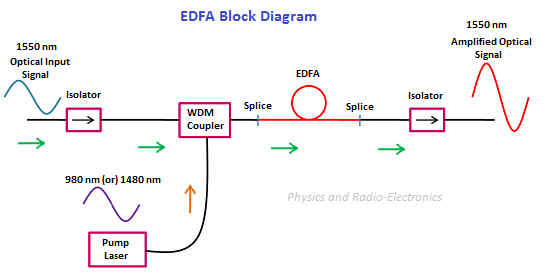
The EDFA is the most widely used amplifier in modern internet infrastructure. It uses a piece of optical fiber “doped” with a rare element called Erbium(that is a metal).
How it Works:
- The Pump Laser: A separate high-energy laser (called a Pump Laser) is injected into the fiber to excite the Erbium ions.
- Energy Transfer: When the weak data signal passes through this “excited” fiber, the Erbium ions give their energy to the signal.
- Amplification: The signal comes out of the fiber significantly stronger than when it entered, all while remaining in light form.
EBFA (Erbium-Bismuth Fiber Amplifier)
- The Evolution: This is an advanced version of the EDFA. It combines Erbium with Bismuth.
- Pros: It provides a much Wider Bandwidth. This allows the fiber to carry even more WDM channels, significantly increasing the total data capacity of the cable.