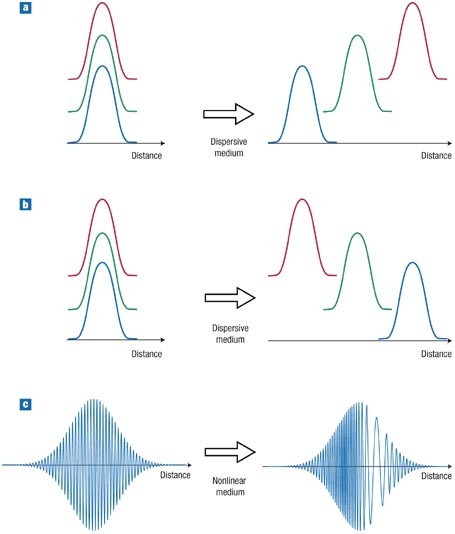
refers to the distortion of the signal’s shape as it travels through the fiber. While Attenuation deals with the loss of power (signal strength), Dispersion deals with the spreading of light pulses over time.This is a major challenge in networking because it limits speed and distance.
Material Dispersion
Optical fiber is made of glass. Different colors (wavelengths) of light travel at different speeds through glass.
The Problem: Light sources like LEDs are not perfectly one color; they contain a small range of wavelengths. Because some colors travel faster and others slower, they arrive at the end at different times. This causes the signal to lose its original sharp shape.
Pulse Broadening
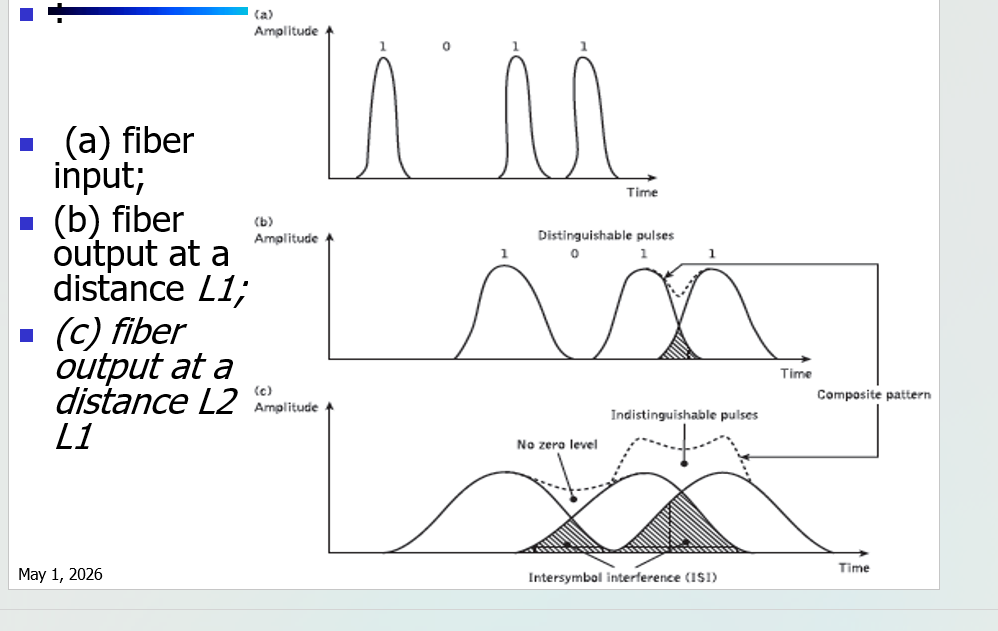
is the increase in the temporal width of an optical signal (pulse) as it propagates through a medium, typically an optical fiber, due to dispersion.
Example: If you flick a flashlight on and off very fast to send a “1” and “0,” by the time it travels miles through a fiber, the light spreads out and becomes an unclear smudge.
Intersymbol Interference (ISI)
This is the most critical concept for CSE students.
How it happens: When a pulse spreads out (broadens) too much, it leaks into the time slot reserved for the next bit.
The Result: A binary “1” becomes so wide that it overlaps with the neighboring binary “0”.
Consequence: The receiver cannot distinguish between the bits. This confusion is called ISI. It leads to data loss, corrupted packets, and slow internet speeds.