Attenuation
in optical fiber is the reduction in signal strength (power) as light travels through the cable, measured in decibels (dB) per kilometer (dB/km). A decibel (dB) is a logarithmic unit used to measure the intensity or loudness of sound, as well as signal power in electronics.
What is Material Absorption?
Material absorption in optical fiber is a mechanism of signal attenuation where light energy is absorbed by the fiber material and converted into heat. It is a primary cause of signal loss, driven by either intrinsic molecular vibrations within the glass or extrinsic impurities (like metal/hydroxide ions) introduced during manufacturing, which limit the transmission distance and efficiency
1. Intrinsic Absorption (Natural Loss) This occurs due to the inherent properties of the fiber’s core material (pure Silica).
- Cause: It happens when the glass molecules interact with light at specific wavelengths, causing the molecules to vibrate and absorb energy.
- Key Point: It is a fundamental characteristic of the material and cannot be completely avoided, even in a perfectly pure fiber.
2. Extrinsic Absorption (External Loss) This is caused by impurities or defects within the glass during the manufacturing process.
- Cause: If tiny amounts of metals (like iron, copper, or chromium) or water (OH⁻ ions/hydroxyl ions) remain inside the glass, they absorb a massive amount of light.
- The “Water Peak”: The OH⁻ ions are particularly notorious for causing high absorption at specific wavelengths (like 1380 nm).
- Modern Status: With advanced fabrication techniques, fibers are now so pure that extrinsic losses have been significantly reduced, allowing for high-efficiency long-distance communication.
Intrinsic Absorption (অভ্যন্তরীণ শোষণ):

UV শোষণ - সিলিকার Si-O বন্ধনের ইলেকট্রনিক শোষণ
IR শোষণ - Si-O বন্ধনের আণবিক কম্পন
Rayleigh Scattering - কাচের অভ্যন্তরীণ কাঠামোগত ওঠানামা

Extrinsic Absorption (বহিরাগত শোষণ):

OH⁻ আয়ন শোষণ - উৎপাদনের সময় পানি দূষণ থেকে
Transition Metal Ion শোষণ - Fe, Cu, Cr, V ইত্যাদি অপদ্রব্য থেকে
What is Linear Scattering?
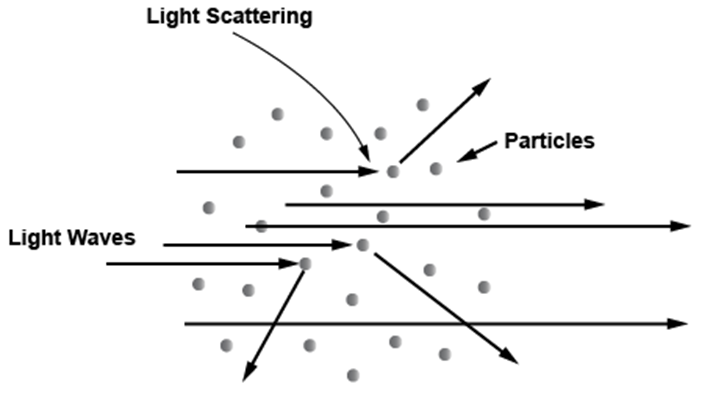
In simple terms, linear scattering occurs when light traveling through the fiber hits tiny particles or microscopic irregularities (inhomogeneities) within the glass. This causes the light to deviate from its original path and spread in different directions.
What is Fiber Bend Loss?
when an optical fiber takes a sharp turn or bend along its path, some of the light energy escapes from the core into the cladding. This is also known as Radiation Loss.
Types of Fiber Bend Loss
Fiber bend loss is generally classified into two types:
1. Macrobending Loss: This occurs due to large-scale bends in the fiber (for example, when the cable is bent at a radius similar to or larger than a human finger). These bends are easily visible to the naked eye.
2. Microbending Loss: This type of loss is not visible to the naked eye. It happens when undue pressure is applied to the fiber or due to manufacturing defects that cause microscopic curves or ripples within the core.
The Main Reasons for fiber bend Loss:
The Evanescent Field: When light travels through the fiber core, a small portion of its energy actually enter slightly into the cladding. This part of the light is called the ‘Evanescent Field’.
The Limitation of the Speed of Light: To maintain a constant Wavefront (a straight line of light moving forward), the part of the light on the outside of the bend must travel much faster than the light on the inside of the bend.
Radiation (Escape of Energy): The problem arises when the light in the cladding (the evanescent field) is required to travel faster than the speed of light in that specific medium to keep up with the wavefront.Since traveling faster than the speed of light in a medium is physically impossible, that part of the light can no longer be guided within the fiber. Result: This energy is “thrown off” or radiated away from the fiber core, causing signal attenuation.
Block by windows

Refractive Index

Relay scattering

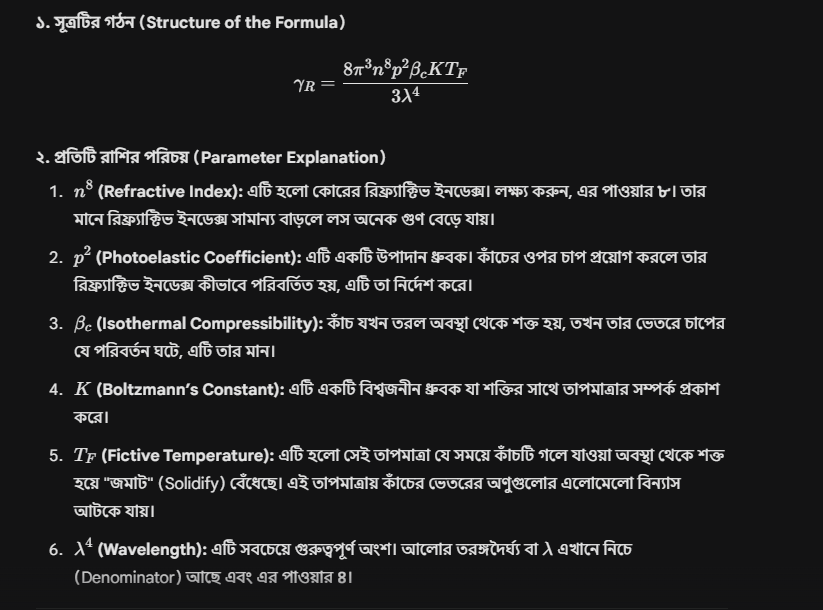
Rayleigh Scattering (রেলে বিচ্ছুরণ) হলো এমন একটি প্রক্রিয়া যেখানে আলোর তরঙ্গদৈর্ঘ্যের (Wavelength) তুলনায় অনেক ক্ষুদ্র কণা বা অণু (যেমন বাতাসের নাইট্রোজেন বা অক্সিজেন অণু) দ্বারা আলো চারদিকে ছড়িয়ে পড়ে।

সহজ কথায়: আলো যখন বাতাসের অতি ক্ষুদ্র কণার ওপর পড়ে, তখন সেটি সবদিকে ছিটিয়ে যায়। এই ছিটিয়ে যাওয়াকেই বিচ্ছুরণ বলে।

Numerical Aperatur
In optics, the numerical aperture (NA) of an optical system is a dimensionless number that characterizes the range of angles over which the system can accept or emit light
Core Concept
When light is launched into an optical fiber, the fiber cannot accept light from all angles. Only light entering within a specific cone, known as the Acceptance Cone, can propagate through the fiber via Total Internal Reflection (TIR).
The Numerical Aperture is defined as the sine of the maximum angle ($\theta_a$) at which light can enter the fiber and still be guided through the core.
Mathematical Definition
The NA is primarily determined by the refractive indices of the core and the cladding.
Based on Refractive Index:
$$NA = \sqrt{n_1^2 - n_2^2}$$
- $n_1$: Refractive index of the Core.
- $n_2$: Refractive index of the Cladding.
Based on the Acceptance Angle:
If light enters from air (refractive index $\approx 1$), the relationship is: $$NA = \sin \theta_a$$ Where $\theta_a$ is the Acceptance Angle.
Critical radious carveture
It is the minimum bending radius of an optical fiber below which the light signal is no longer confined to the core by total internal reflection. If the fiber is bent beyond this radius, significant radiation losses (attenuation) occur as light leaks into the cladding.